Farmer Grey’s farm
Black BeautyFarmer Grey’s farm is Black Beauty’s childhood home and the pastoral setting of his earliest memories. Its meadow, pond, grove, and brook provide a place for play and shelter, while Duchess and the kind master shape his first experience of care. The farm’s significance lies not only in its landscape but in the standard of humane treatment against which the hardships of Black Beauty’s later working life can be measured.
Setting and Landscape
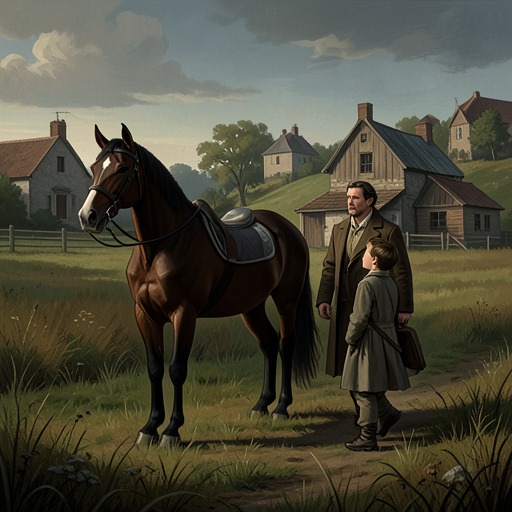
Black Beauty remembers the farm first as a broad meadow with a pond of clear water. Shade trees lean over the pond, and rushes and water-lilies grow at its deep end. A plowed field lies beyond one hedge; over a gate on the other side stands the master’s roadside house. Fir trees mark the upper end of the meadow, while a running brook passes below a steep bank at the bottom. These details make the place a lived environment, with water, shelter, and room to move, rather than a mere backdrop.
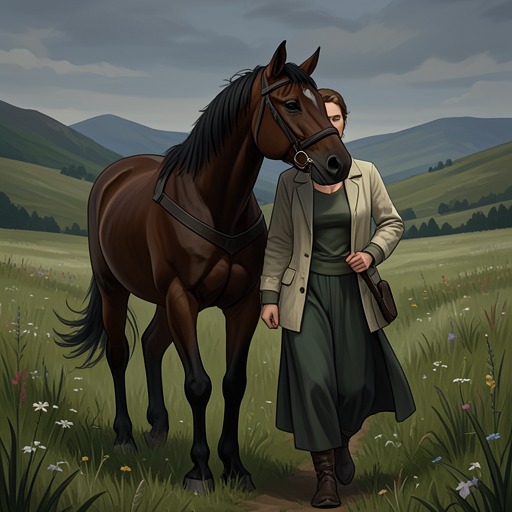
The changing weather shapes the young horse’s use of the farm. In hot weather, he and Duchess stand in the shade beside the pond; in cold weather, they have a warm shed near the grove. As a foal he stays close to his mother, drinking her milk, running at her side during the day, and lying beside her at night. Once he is old enough to eat grass, Duchess goes out to work in the daytime and returns in the evening, linking the meadow’s security to the labor that sustains the household.
Early Life and Care
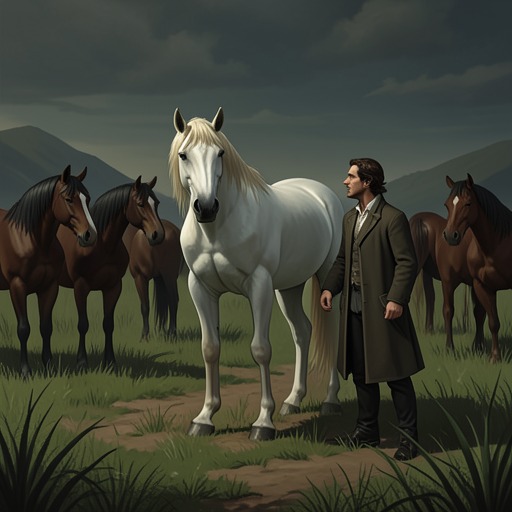
Six older colts share the meadow with Black Beauty. Their rough play includes biting and kicking as well as galloping, and Duchess calls her son away when the play becomes too forceful. She teaches him to remain gentle, to work willingly, and not to bite or kick even in play. Her advice joins the setting’s freedom to a practical moral education: growing up among other horses does not excuse cruelty or bad manners.
The master treats the horses with food, good lodging, and kind words, speaking to them as kindly as he does to his children. He is especially affectionate toward Duchess, whom he calls Pet, and toward her foal, whom he nicknames Darkie for his dull-black coat. He gives Black Beauty bread and sometimes brings Duchess a carrot. On market days, Duchess takes him to town in a light gig. The farm is therefore both a place of pasture and a household where horses are known individually and included in ordinary routines.
The meadow is not entirely free from danger. Dick, a plowboy who comes to pick blackberries from the hedge, sometimes throws sticks and stones at the colts to make them gallop; although they can run away, a stone occasionally hits and hurts them. When the master sees Dick doing this, he intervenes and stops him. The episode shows that the farm’s humane character depends on active protection, not simply on the open landscape: the master notices how the horses are treated and acts against deliberate harm.
Departure and Change
As Black Beauty matures, his appearance changes from a young foal’s dull black coat to a fine, bright-black coat, with one white foot and a white star on his forehead. The master refuses to sell him before he is four, holding that colts should not be made to work like horses before they are fully grown. When Squire Gordon comes to inspect him at that age, the examination includes his eyes, mouth, and legs, and Black Beauty is asked to walk, trot, and gallop. The master undertakes to break him in himself so that the process will not frighten or hurt him.
In early May, after Black Beauty’s coat has been brushed until it shines, a man from Squire Gordon’s household comes to take him away. The master bids him do his best, and Black Beauty answers by putting his nose into the man’s hand before leaving his first home. The departure marks a clear transition from the familiar farm to Birtwick Park, where he will spend the next phase of his life. The farm’s protection has prepared him for work without making it seem harmless or inevitable.
Place in the Narrative
The farm gives the autobiography its first measure of what a horse’s life can be: space to run, shelter suited to the weather, a mother’s instruction, and human care attentive to an animal’s needs. Black Beauty’s recollections are grounded in ordinary particulars—the pond, the shed, the bread, the market-day gig—so the account of early security rests on daily experience rather than an abstract ideal.
The farm should not be confused with Birtwick Park. At the close of his story, Black Beauty says that he sometimes imagines himself in the orchard at Birtwick among old friends beneath the apple trees. That final image belongs to a later home, while Farmer Grey’s farm remains the remembered landscape of his beginnings. Together, the two places frame a life repeatedly shaped by the conditions humans provide for horses.